
Fenton - Horse Chestnut
COMPANIONS of the “HORSE CHESTNUT” Pattern
In deference to the late Don Moore, who along with being an eminent collector “in the early days”, became an avid student and researcher in the area of carnival glass and its many implications. He wrote extensively until his passing in 1991, providing impetus and education to all collectors. His claim to this “Horse Chestnut” tag, was that it seemed easier to remember than “Berry and Leaf Circle” or “Paneled Berry” applied by Bill Edwards. Interestingly, Mrs. Hartung only referred to the design by saying it looked like cherries. Mrs. Presznick, another of the early writers makes no reference to it. Don continues his explanation of the usage this way: “ I do not know just where I picked up this name but suspect it was from Sherman Hand. (another pioneer in CG collecting). The buckeye is the seed of the horse chestnut, so this name tag should have the full support of all you Ohio collectors….O.K. So it does not look like a horse chestnut. Picky, Picky. Since when does the pattern name have to look like the real thing?” …..Fair enough! We go along with that line of thinking, as well!
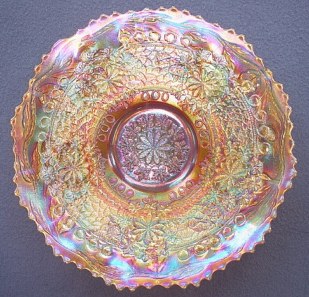
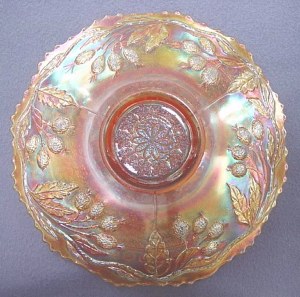
You folks may be surprised to learn how extensively Fenton used this pattern. Molds have always been expensive. By using the bottom part of the mold, changing only the plunger, or interior portion of the mold, the company was able to produce a wider range of patterns at half the cost. This practice was also followed by Northwood with use of their Basketweave exterior, Millersburg with their Wide Panel and of course Fenton in their use of the Bearded Berry exterior, used almost as often as they used this Horse Chestnut.
Let's take a look now at the specific Fenton patterns where the Horse Chestnut was applied as the exterior design. Of course, they are all the same size. All are on a collar base and may be found either in a bowl or plate shape. When flattened into a plate, they will run about 7 ½”, depending on the depth. Bowls may be anywhere from 6” to 71/4” diam., depending on depth and the type of ruffle used. Some of the bowls will be found in ice cream, or circular shape, again with somewhat of a variance in size.
|
||
 |
|
 |
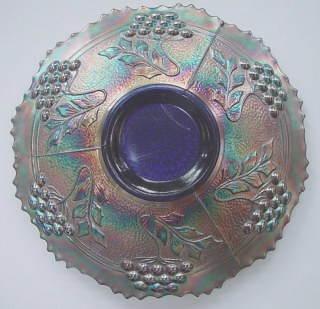
Horse Chestnut or Berry & Leaf Circle
|
|
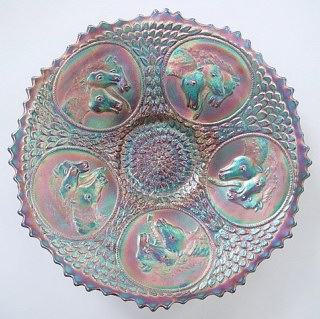
Horse Medallion
|
This may be the most plentiful and best known of the pieces found with this exterior pattern. The bowl is found in green, blue, amethyst, marigold, aqua, Vaseline and red. It has been reported in white, but we have never seen an example. The plate is much harder to find and is known in blue, amethyst and marigold, with blue and amethyst considered VERY difficult, at best. The rose bowl and jack-in-the-pulpit shapes are from another mold, having three curled feet. These pieces carry the Wide Panel exterior.
|
||
 |
|
 |
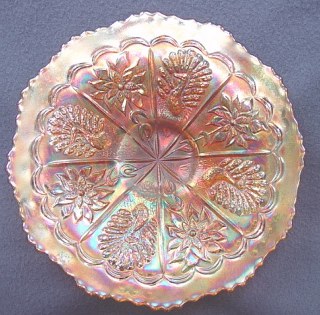
PEACOCK & DAHLIA
Possibly the bowls could not be termed rare, but certainly they are seldom seen. The 7 ½” plates should be considered rare. These are in the marigold color. Bowls can be found in blue, amethyst, marigold, vaseline and aqua.
|
|
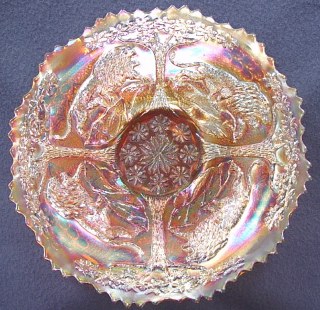
LION
This is found in blue and marigold bowls and marigold plates like the one shown. Blue bowls and marigold plates are not easily discovered. Many collectors enjoy gathering up as many animal patterns as they can obtain.
|
 |
|
 |
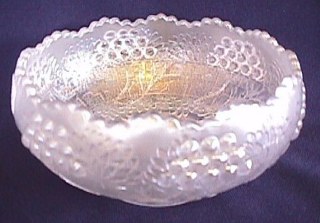
MIRRORED LOTUS
Only three or four of the white rose bowls are known. There are also marigold rose bowls. Blue and marigold ruffled bowls are hard to find. An ice blue Mirrored Lotus plate turned up at the 1982 ACGA Convention in Dayton, Ohio. The late/great Smokey Cloud of MI purchased it with great pride. He was a small plate collector. It is told that his feet never touched ground again after coming up with that super rarity! He retained ownership of that plate until his passing some years later.
|
|
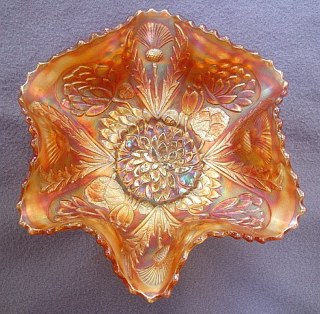
THISTLE and LOTUS
Mrs. Hartung and Don Moore called this by the name given here. It is the one we prefer to use, in spite of the fact that some price guides place the name Lotus first. This seldom seen pattern is definitely “evasive”! At this writing, public auction results indicate that only four bowls have sold during the past twelve years………definitely NOT in the “available” category of Peacocks! The photo illustrates a lovely 6 ¼” bowl which required nearly 20 years of determination (to be in the right place at the right time). WINNAH!! Of the four mentioned sold at auction: one was blue, three in marigold, and all were ice cream shape….for whatever interest that conjures up. ALL collectable carnival glass need NOT be in the thousand dollar range to be very desirable and valuable, in spite of what you my have been led to believe!
|
 |
|
 |
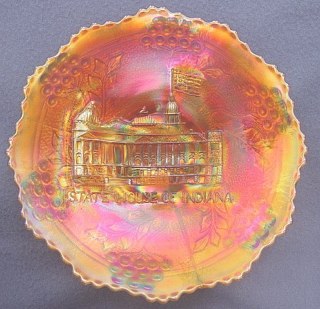
INDIANA STATEHOUSE PLATE
It is interesting that this pattern was made only in a 7 ½-8” plate. At least no bowls have turned up, to our knowledge. Four pieces are known in this pattern: two marigold plates and two blue plates. It was created as a commemorative to the Indiana State Capitol Bldg. One of the marigold plates brought $16,000 in a 1994 auction. What IS a commemorative? An object created to memorialize an event, such as dedication of a new building or structure of historic importance.
|
|
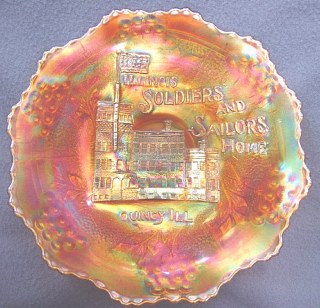
ILLINOIS SOLDIERS AND SAILORS
Only commemorative plates in blue and marigold are known. Which is the more available is left to speculation. Both colors will sell in much the same price range whenever they surface. 7-8” in size, these surface on occasion, and will bring somewhere in the neighborhood of $1500-$2900 depending on condition of the plate.
|
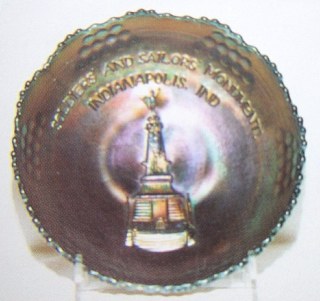 INDIANAPOLIS SOLDIERS and SAILORS MONUMENT
Only one blue plate and one blue bowl are known to exist in this commemorative to an absolutely wonderful War Memorial which stands in a downtown Indy square for public appreciation. It most adequately competes with any of the historic monuments in Washington, D.C. …. $10,000 was paid for the bowl in 1994. 7 ½-8” is standard size for these.
|
||
 |
|
 |
LEAF CHAIN
|
|
Bearded Berry
|
Plate, which has the Bearded Berry exterior. The 7 ½” size plate in that pattern is not rare by any standard. It does have the Horse Chestnut pattern on the exterior. We simply do not have an example to show you. The smaller size plate is known in blue and marigold. 7” Bowls can be found in green, amethyst, marigold , blue, ice green, red, aqua, vaseline , white and clambroth.
|
||
In case you feel you have been overdosed on Horse Chestnut, you'll be happy to know that we have shared all we know on that subject! (smile) As compared to Northwood, Dugan and Imperial, little has been documented by current day collectors of the Fabulous Fenton array of Carnival Glass. Their ample contribution toward our pleasures and desires are always a joy to discuss. Their plates are flatter than most and display quite nicely. It would be a major undertaking for any author to compile extensive information concentrating on the Fenton “odyssey”. Their history is colorful and extends over more than 100 years of artistry. Fenton Carnival Glass in patterns alone, covers a multitude of subject matter. The dedication of those early craftsmen who created the gorgeous designs from nature and the elements from their surroundings for us to enjoy, deserve our applause! Working with chisel and hammer, the outcome is unequaled by ANY brush and canvas artist. It is a lost art….Keep yourself abreast of re-use of the old molds and a forgery of colors introduced to gullible buyers! They are out there!
Dean & Diane Fry….9/03



Should you care to contact the Frys, their email address is:
Search Our Sites
back to Carnival Glass 101
Our other sites you may enjoy:
Everything you EVER wanted to know about Indiana Glass
Great Reference for Newer Carnival Glass.
Complete Glassware Catalogs Available to Download
Questions? Comments? Suggestions? Broken Links? Corrections?
Your Friendly Webmaster is here to help!